
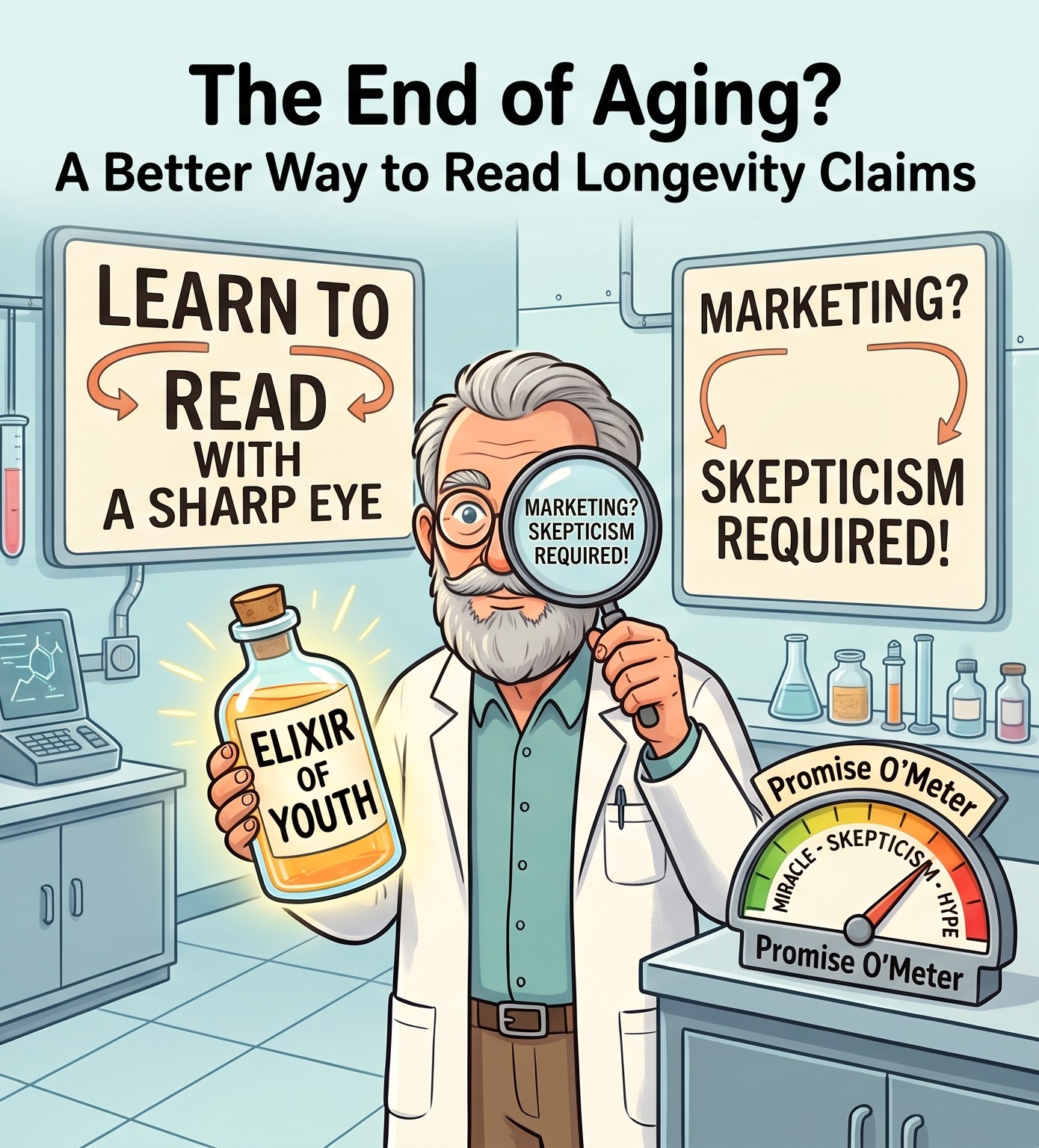
Stories about “reversing aging” are irresistible. They offer a clean answer to a complicated reality. A blood test moves. A clock looks younger. A headline writes itself. But a change in one laboratory marker is not the same as a person becoming younger, avoiding disease or living longer.
The research is often real. The leap from dish, mouse or short human trial to a product promise is where the trouble starts. Healthy Agers treats longevity science as something worth following — and worth reading slowly.
What the headline usually hides
“Reversing aging” can mean several different things, and they are not interchangeable:
- a molecule or gene activity changed in cells
- a biological-age score moved on a commercial or research clock
- one symptom or lab value improved in a small group
- mice lived longer under tightly controlled conditions
- people kept more function for longer — walking, strength, memory, independence
Only the last item is close to what most readers actually want. The first four can still be useful science. They are not proof that a supplement, clinic or protocol has turned the clock back in daily life.
Three questions before believing the headline
- What actually changed? A molecule, a test score, symptoms, physical function or survival? A younger-looking clock is not the same as fewer heart attacks, stronger legs or more years of independent life.
- Who was studied? Cells, animals, a small selected group or a representative human population? Results from young mice, elite athletes or paying clinic patients rarely travel unchanged into ordinary lives after 50.
- How long did the effect last? A short experiment may not predict long-term benefit or harm. Aging is measured in years. Many claims are measured in weeks.
Two extra questions help when money is involved: who paid for the study, and is the “breakthrough” already for sale? Funding does not make a finding false. It does mean the press release should not be the only document you read.
Biological age is a tool, not a verdict
Epigenetic clocks and similar scores can be useful in research. They try to estimate biological wear from patterns in DNA or blood. That is interesting. It is not a courtroom verdict on your next decade.
Different clocks can disagree. Scores can move with illness, medication, sleep loss or a short training block. A lower number after eight weeks does not prove that joints, arteries and memory have become eight weeks younger.
Use a score, if you use one at all, as one signal among others: how you walk, recover, sleep, carry shopping, and stay connected. Function is harder to market. It is closer to the life you are trying to keep.
Healthspan is the practical target
For everyday decisions, protecting functional ability is often a more useful goal than trying to lower a single “biological age” number. Can you carry, walk, recover, think, connect and contribute?
Lifespan is how long you live. Healthspan is how long those years stay usable. Most of the habits this site talks about — strength, walking, food patterns, sleep, not smoking, preventive care, other people — are aimed at the second of those, not at winning an argument with a clock.
That target also keeps claims honest. If a protocol cannot show better function, fewer events or a clearer daily life, a prettier lab number is not enough.
How Healthy Agers reads new claims
Science moves forward through uncertainty and correction. That is not a weakness. It is why Healthy Agers will celebrate promising research without selling certainty it has not earned.
A fair reading usually sounds like this: the finding is interesting; the sample is small; the follow-up is short; the human relevance is not settled; the next study should test function, not only a marker. That sentence is less exciting than a headline. It is closer to how good labs talk when the cameras are off.
Skepticism here is not cynicism. It is a way to stay curious without handing your week to every new protocol.
Continue with a practical next step
Choose one action small enough to repeat this week. Healthy aging is built through patterns, not one heroic day.
If a claim made you restless, spend the energy on something already well supported: a walk you can repeat, two strength sessions, an earlier wind-down, or the preventive appointment you have been postponing. Those actions will still matter if next month’s headline is quieter.
For the wider map, see the healthy aging guide (read the guide), the Healthy Aging Blueprint (read the blueprint), and Genes or Lifestyle.