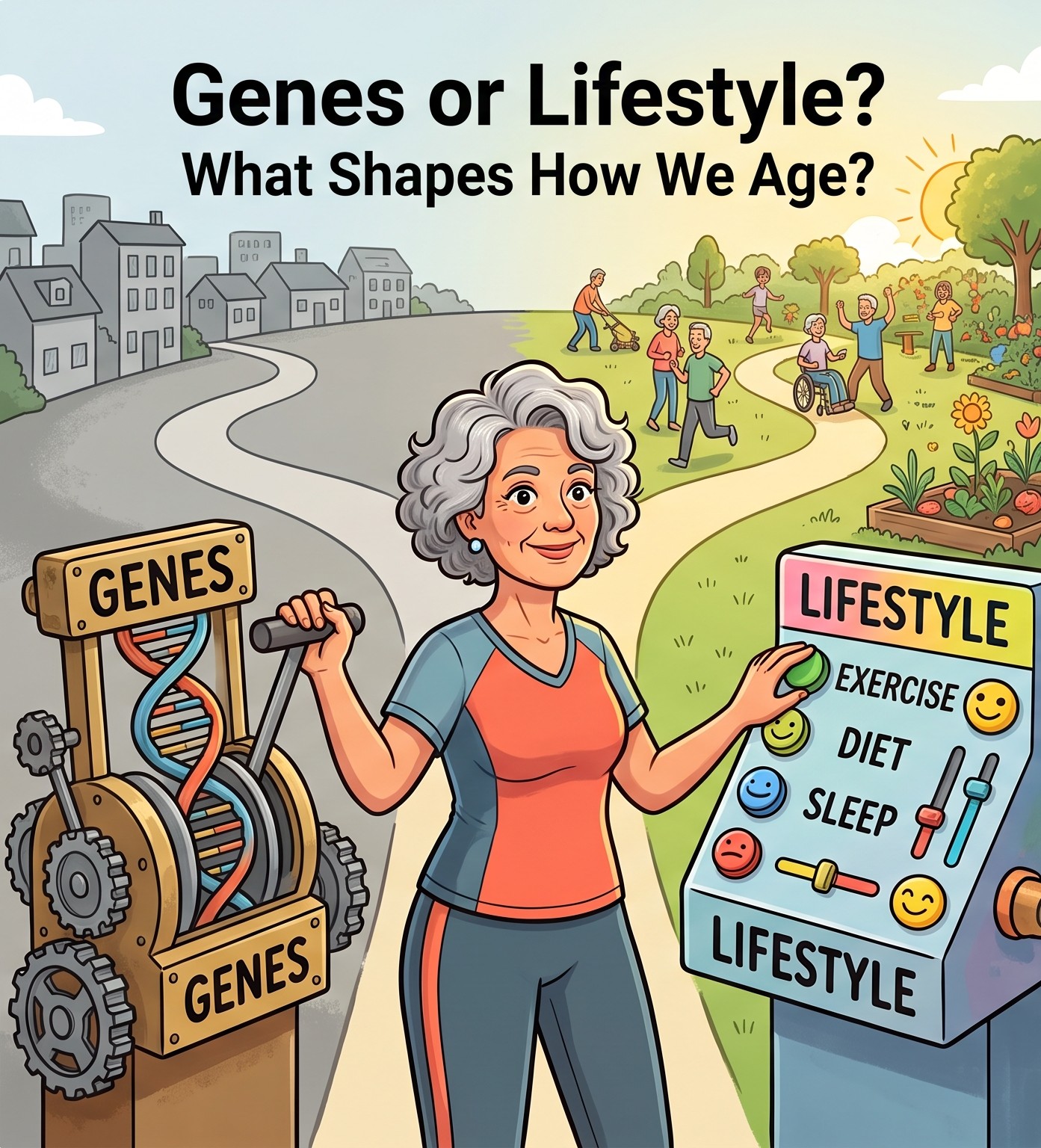
People want a clean split: how much is genes, how much is lifestyle? The honest answer depends on the outcome, the population, the environment and the age being studied. Inherited differences can affect risk and resilience. Living conditions, healthcare access and chance affect how those risks show up. Habits sit in the middle: they are not the whole story, and they are not nothing.
A useful question is not “who is to blame?” It is “which levers can I still reach this week?”
Genes are not a complete script
Genes influence how we age. That is not controversial. Family patterns in heart disease, some cancers, body composition and longevity are real. Twin research and family studies show that part of the variation in lifespan and many health traits is heritable.
Heritability is often misunderstood. It is not a personal percentage tattooed on one body. It is an estimate for a group, in a particular time and place. Change the environment — food supply, smoking rates, infection, medical care — and the same genetic differences can look larger or smaller.
Genes also do not write a fixed ending. Many inherited risks are probabilities, not destinies. Two people with a similar family history can have very different decades, depending on what happens around them and what they repeat.
Lifestyle is not total control
Healthy habits do not make somebody responsible for every illness. This matters ethically as well as scientifically.
People get sick despite careful routines. People live long lives despite imperfect ones. Chance, early life, work, money, housing, injury and medical luck all sit outside a morning walk. If a community talks about habits as if they were a moral exam, it quietly punishes the people who already carry the heaviest load.
That is a poor way to talk about health. It also makes worse science. Lifestyle research is strongest when it describes patterns in populations, not when it is used to score one person’s character.
Use agency without blame
Move, eat, sleep, connect, avoid smoking and use preventive care because these actions can support health — not because they guarantee a specific lifespan.
Agency is still useful. You can choose the next walk, the next meal pattern, the next bedtime, the next appointment. You can make the helpful choice easier and the unhelpful one slightly harder. That is not the same as claiming you control every outcome.
A practical way to hold both truths:
- Take credit for the routines you keep.
- Do not take the blame for every diagnosis.
- Change what is changeable. Get help with the rest.
If a habit only works when life is calm, it is not yet a habit. Build the small version that survives a messy week.
Houses, garbage and trucks (one researcher’s metaphor)
Systems biologist Uri Alon has used a vivid picture for aging and damage: imagine houses (cells) that produce garbage (cellular waste). Over time, garbage trucks (clearance systems) may keep up less well, so mess accumulates.
In that picture, “garbage” can include damaged proteins and worn-out cells. “Trucks” can include immune clearance and the body’s own repair work. “Houses” are the long-lived parts of the system that have to keep functioning for decades.
Lifestyle habits — sleep, movement, not smoking, nourishing food — can be framed as ways to support the trucks and reduce unnecessary mess. Better sleep and regular activity are not magic anti-aging protocols. They are ordinary supports for systems that already work hard.
Treat this as a helpful metaphor from one scientist’s talks and writing, not as settled gospel and not as a precise split between genes and lifestyle. Models are useful when they make the next action clearer. They become unhelpful when they are sold as a complete map of a human life.
Consistency beats dramatic resets
Twin studies and heritability estimates are often misquoted as “X% genes, Y% lifestyle.” Those numbers depend on the trait, age group and environment studied. Quote them as a slogan and you usually get the science wrong.
A more useful takeaway: repeated ordinary routines usually matter more than a single perfect week.
A heroic seven-day reset can feel meaningful. It rarely becomes the year. The pattern that shows up in research on movement, food, sleep and smoking is repetition over time, not intensity for a fortnight.
Pick habits you can keep — then adjust. That usually means:
- a walk most days rather than a plan that needs a free Saturday
- two strength sessions you can actually attend
- meals you can cook on a tired evening
- a wind-down that starts before you are already exhausted
- contact with people that does not require a perfect calendar
If a plan only works in January, it is not the plan.
Continue with a practical next step
Choose one action small enough to repeat this week. Healthy aging is built through patterns, not one heroic day.
Examples that are small enough to count:
- a 12-minute walk after lunch on four days
- two short strength sessions with movements you already know
- protein at breakfast instead of a complete diet overhaul
- lights down and screens away 30 minutes earlier on weeknights
- one real conversation that is not a task list
Write the action where you will see it. Review it after seven days. Keep what was manageable. Shrink what was not.
Where to go from here
For a practical starting map, see our healthy aging guide (read the guide) and the Healthy Aging Blueprint (read the blueprint). You may also like The End of Aging?.
The 80/20 idea on this site is the same point in different clothes: choose a few levers, make them easier, repeat them long enough to matter. You do not need a new identity by Monday.