
Paper still works. A sheet on the fridge or next to your favorite chair is a quiet reminder that does not need a phone, an app or a password. Each sheet below fits on one page (US Letter, and it prints fine on A4 with “fit to page”). The text is large, the pictures are simple, and every exercise has a starting amount.
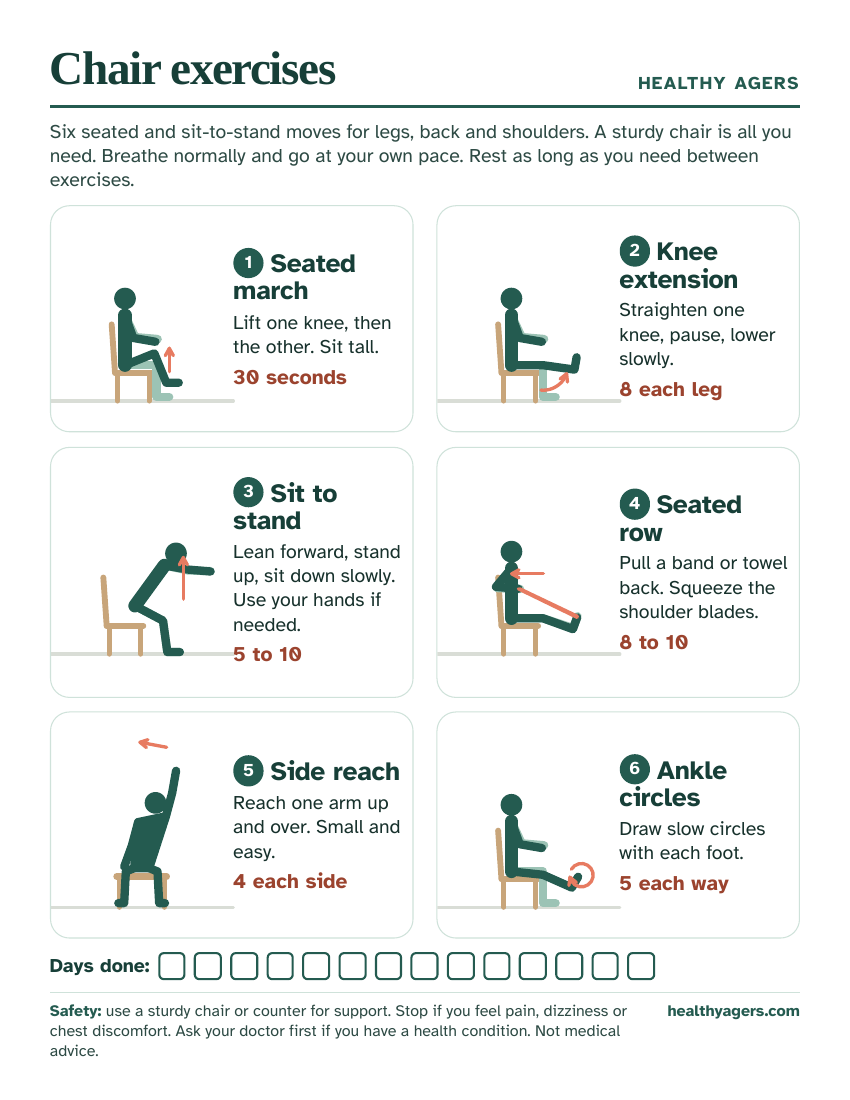
Chair exercises
Six seated and sit-to-stand moves for legs, back and shoulders. A sturdy chair is all you need.
Download PDF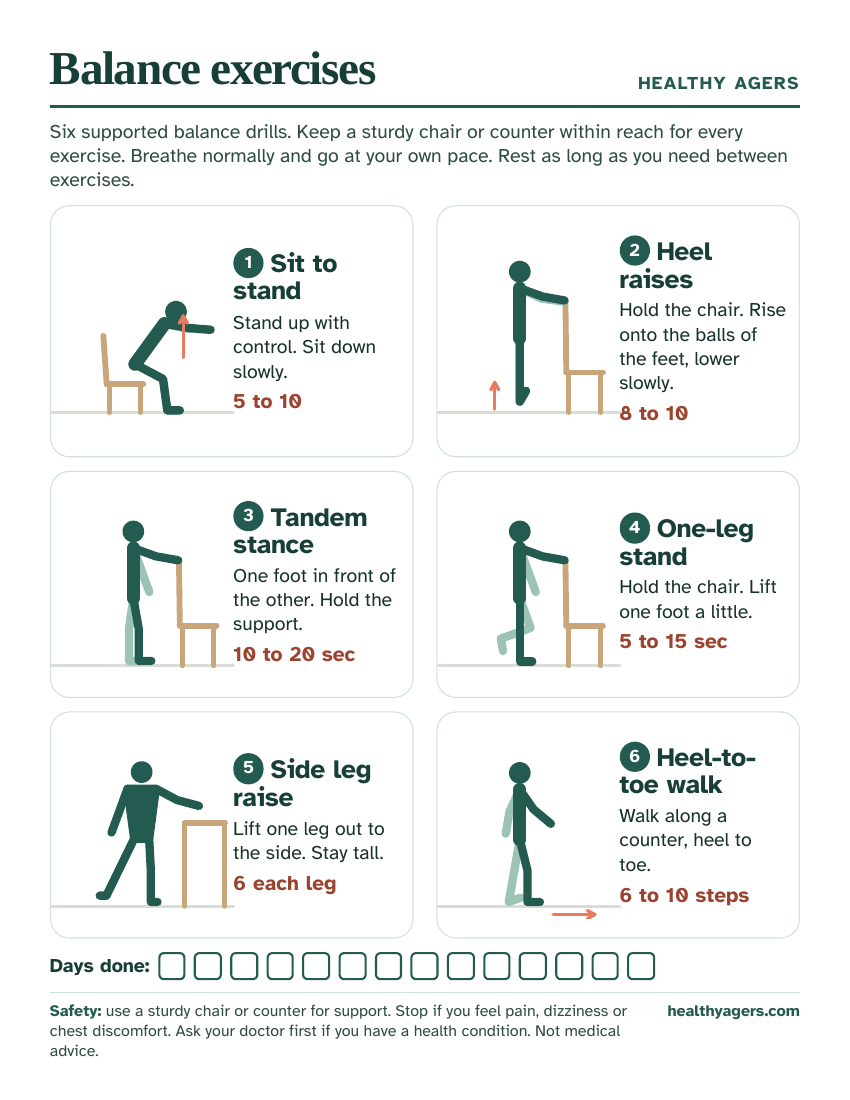
Balance exercises
Six supported balance drills. Keep a sturdy chair or counter within reach for every exercise.
Download PDF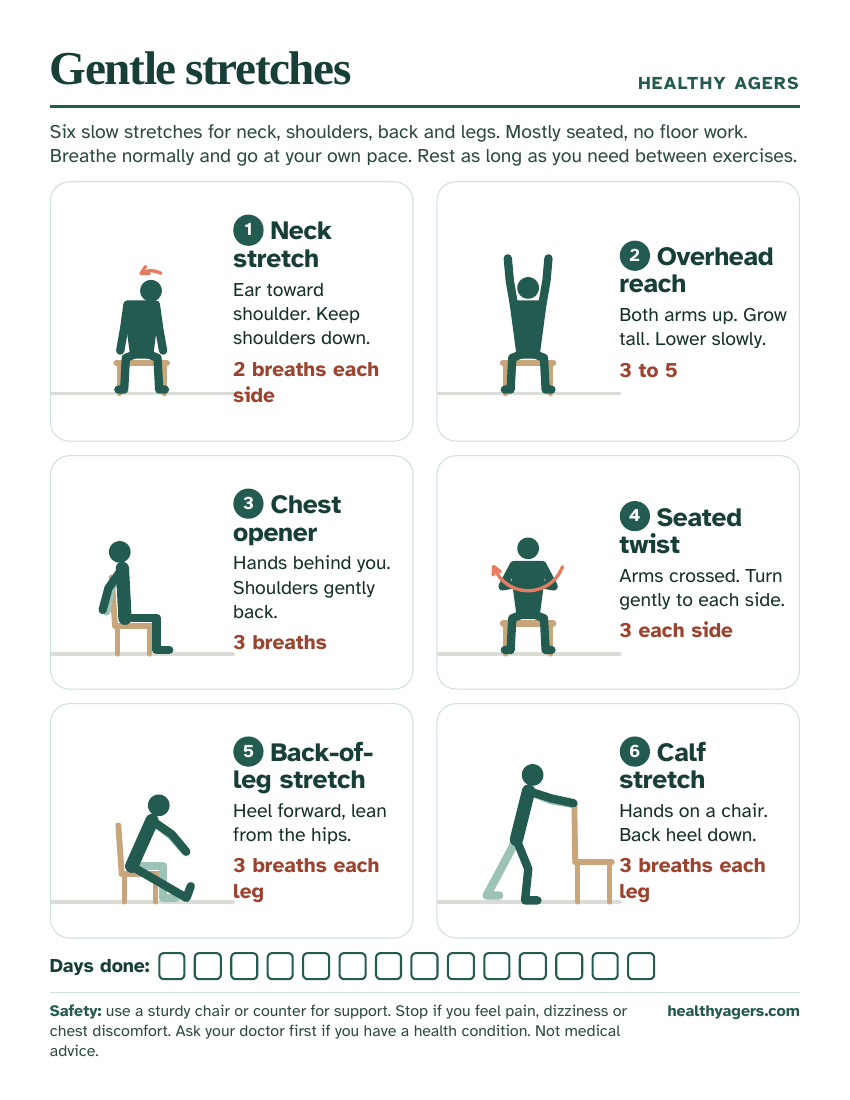
Gentle stretches
Six slow stretches for neck, shoulders, back and legs. Mostly seated, no floor work.
Download PDFWhat is on each sheet
Chair exercises sheet
- Seated march: Lift one knee, then the other. Sit tall. (30 seconds).
- Knee extension: Straighten one knee, pause, lower slowly. (8 each leg).
- Sit to stand: Lean forward, stand up, sit down slowly. Use your hands if needed. (5 to 10).
- Seated row: Pull a band or towel back. Squeeze the shoulder blades. (8 to 10).
- Side reach: Reach one arm up and over. Small and easy. (4 each side).
- Ankle circles: Draw slow circles with each foot. (5 each way).
Balance exercises sheet
- Sit to stand: Stand up with control. Sit down slowly. (5 to 10).
- Heel raises: Hold the chair. Rise onto the balls of the feet, lower slowly. (8 to 10).
- Tandem stance: One foot in front of the other. Hold the support. (10 to 20 sec).
- One-leg stand: Hold the chair. Lift one foot a little. (5 to 15 sec).
- Side leg raise: Lift one leg out to the side. Stay tall. (6 each leg).
- Heel-to-toe walk: Walk along a counter, heel to toe. (6 to 10 steps).
Gentle stretches sheet
- Neck stretch: Ear toward shoulder. Keep shoulders down. (2 breaths each side).
- Overhead reach: Both arms up. Grow tall. Lower slowly. (3 to 5).
- Chest opener: Hands behind you. Shoulders gently back. (3 breaths).
- Seated twist: Arms crossed. Turn gently to each side. (3 each side).
- Back-of-leg stretch: Heel forward, lean from the hips. (3 breaths each leg).
- Calf stretch: Hands on a chair. Back heel down. (3 breaths each leg).
There is also a one-page checklist for five daily exercises with boxes to tick for each day of the week. It goes with the guide 5 exercises for seniors to do every day.
How to use the sheets
- Pick one sheet. Starting with all three at once is a common way to stop after a week.
- Do the starting amount. The numbers on the sheet are a beginning, not a test. Fewer is fine on a tired day.
- Tick the box. Write the date at the bottom of the sheet each time. Seeing a row of marks helps more than willpower.
- Add a little after two calm weeks. One or two more repetitions, a slightly longer hold, or less hand support.
Public-health guidance for adults 65 and older includes muscle-strengthening activity on at least two days a week and activities that improve balance, such as standing from a sitting position or walking heel-to-toe (CDC). The chair and balance sheets cover both. If you are new to exercise, the chair exercises guide and the balance exercises guide explain each movement in more detail, with easier and harder versions.
Safety first
- Stop for chest pain, faintness, unusual shortness of breath, or sudden joint pain, and seek appropriate medical help.
- If you have osteoporosis, a recent surgery, dizziness, or a fall history, ask a clinician or physical therapist how to adapt these movements.
- Use a sturdy chair without wheels. Put it against a wall if it slides.
- Ordinary muscle effort is fine. Sharp or worsening pain is a signal to stop.
For balance work, keep a sturdy support within reach and, if you feel unsteady, practice when someone else is at home.
For groups, classes and caregivers
Senior centers, libraries, activity coordinators and family caregivers are welcome to print the sheets and hand them out free of charge. Please keep them unchanged, with the Healthy Agers address at the bottom, so people can find the full instructions. If you link to them, link to this page rather than to the PDF files, because the files may be updated.
FAQ
Are the exercise sheets really free?
Yes. Download and print them without signing up or giving an email address.
Can I print them for a class or a senior center?
Yes. You are welcome to print and share them free of charge, unchanged and with the Healthy Agers web address at the bottom.
Which sheet should I start with?
If standing feels unsteady, start with the chair sheet. If you can stand comfortably near a support, add the balance sheet. The stretch sheet works well after a walk or at the end of the day.
How often should I use them?
Two or three days a week is a realistic start for the chair and balance sheets. Gentle stretches can be done most days if they feel good.